Designing a unified digital assistant to help customers discover integrated product solutions across VMware's fragmented ecosystem—conceived in 2021, before conversational AI became ubiquitous.
VMware's extensive product portfolio had become a double-edged sword. While the company offered comprehensive solutions across cloud infrastructure, networking, security, and application platforms, customers struggled to discover how these products could work together.
Products were developed independently across business units, creating silos that prevented customers from unlocking the full value of their VMware investments. IT administrators purchased specific products but remained unaware of complementary solutions that could enhance their workflows.
This design borathon challenge asked: How might we connect VMware's ecosystem to help customers do more with every product?
Through research and stakeholder interviews, we identified critical pain points affecting both customers and VMware's business objectives.
Customers didn't know where to find relevant product information, missing opportunities to leverage VMware solutions that could enhance their services and solve technical problems.
VMware products weren't integrated enough. Customers found navigating across products confusing and perceived integrated solutions as too expensive or complicated.
VMware was leaving revenue on the table by not presenting clear, accessible cross-product solutions. Poor cross-BU communication hindered product marketability.
We proposed VMware Solution Navigator—a widget application that ships with every VMware product, acting as an intelligent guide to help users discover integrated workflows, documentation, and cost-saving product combinations.
A note on timing: This concept was developed in November 2021, more than a year before ChatGPT and the explosion of AI chatbot interfaces. Our vision of an intelligent, conversational assistant embedded directly into enterprise software demonstrated prescient thinking about how AI could transform product discovery and cross-platform integration.
Solution Navigator functions as "a mini Launchpad" embedded in each product, powered by an AI and ML-aggregated database of VMware's entire product catalog. It provides contextual, real-time recommendations based on what users are trying to accomplish.
The diagram above illustrates how the widget sits at the center of VMware's product ecosystem, intelligently connecting customers to integrated workflows across all products through a unified knowledge base.
The assistant provides contextual content tailored to each user's workflow and technical challenges.
Step-by-step guidance for accomplishing tasks across multiple VMware products, with simplified workflows that reduce complexity.
Documentation, blog posts, videos, and customer reviews surfaced contextually based on what users are trying to accomplish.
Connect with VMware experts and access promotional discounts on complementary products that enhance existing solutions.
To illustrate Solution Navigator's value, we created a user journey following Jason, a Cloud Admin at Hardtop Hotels.
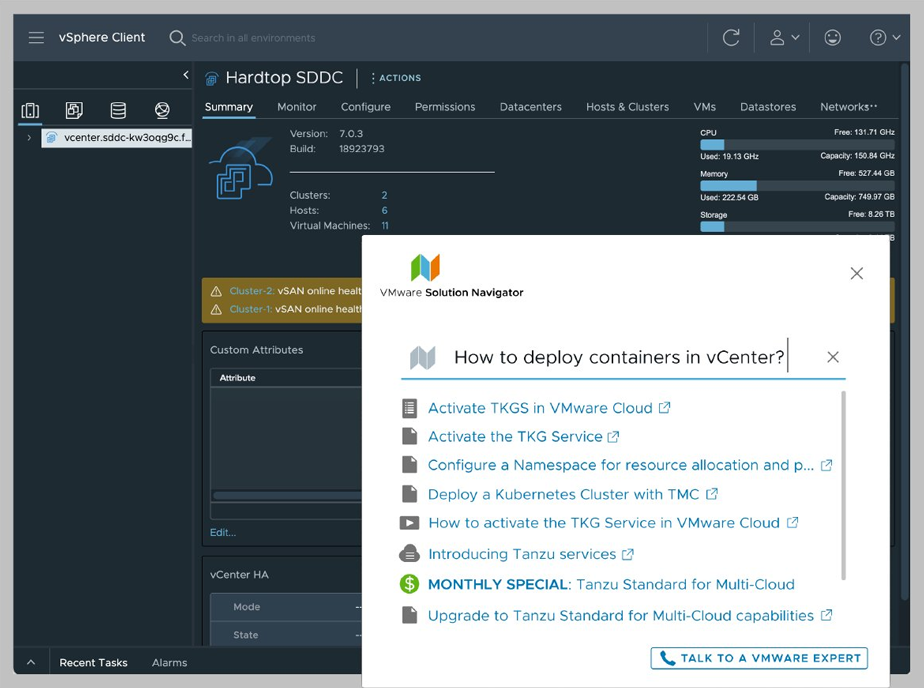
Jason heard that customers can now run containers on vSphere 7 and wanted to explore Kubernetes deployment. However, he didn't know where to start or which VMware products could help.
Jason noticed the Solution Navigator widget icon in the bottom-right corner of his vSphere Client screen. Clicking it revealed a search panel where he entered: "How to deploy containers in vCenter..."
Jason clicked "Activate the TKG Service," which launched a guided journey in VMware Cloud's Launchpad. Within minutes, he had Tanzu Kubernetes Grid Service activated on his cluster—a process that would have required extensive research and trial-and-error otherwise.
Solution Navigator was designed to create value for both customers and VMware by turning product fragmentation into a strength.
The assistant increases work efficiency and productivity by surfacing cost-saving solutions and improving product discoverability. Customers gain domain knowledge and develop stronger relationships with VMware experts, while experiencing greater product interoperability across their infrastructure.
For VMware, the initiative drives increased product consumption and customer loyalty. By improving cross-BU collaboration and tightening product integration, VMware can better market integrated solutions. The assistant also reduces support costs through self-service guidance and creates new advertising opportunities within the existing customer base.
This design borathon challenged us to think holistically about VMware's product ecosystem rather than optimizing individual products. The most valuable insight was recognizing that customers don't think in terms of business units—they think in terms of problems to solve.
We designed Solution Navigator in November 2021—more than a year before ChatGPT's release and the subsequent proliferation of conversational AI interfaces across enterprise software. The concept of an embedded, context-aware assistant that could understand natural language queries and surface integrated solutions was innovative for enterprise B2B products at the time.
This timing demonstrates vision and intuition about where software interaction patterns were heading. While consumer AI assistants like Siri and Alexa existed, applying conversational AI to complex enterprise workflows—particularly for cross-product integration and discovery—represented forward thinking that would only become standard practice years later.
Solution Navigator represented a shift from product-centric to outcome-centric design. Rather than asking "How do we improve Product X?" we asked "How do we help customers accomplish Goal Y across our entire portfolio?" This reframing opened new possibilities for creating value through integration rather than feature expansion.
While this remained a concept project, it influenced subsequent thinking about cross-product integration at VMware and established patterns for contextual assistance that would prove increasingly relevant as AI capabilities matured.